Cantors Assembly Solidarity Mission Day 4 part 1
As I was checking in to our midnight flight home, I looked back at my “notes” app to reflect on the day. It was hard to imagine all that we fit in our final day in Israel- the itinerary, the interactions, the emotions. I’m going to try to fit it all into two posts as I sit here in the middle row at 9am (or really now 2am). A note on the photos- they will be a mishmash of happy and sad- of note, I hope that you’ll be able to feel the ways in which Israel and Israelis are trying to process this war, just as I have just started to figure how I process what we’ve seen and experienced.
Israelis keep i24 on all the time- on tvs, on their smartphones. It’s not background noise- it’s the passing of information in real time. In similar fashion I refresh my Times of Israel or Haaretz main page seemingly every five minutes. Immediately following breakfast (sharing a video montage for a little levity),
I read about a terrorist attack in Jerusalem. Within minutes, security footage is posted on X to reveal two Hamas gunmen shooting up a Jerusalem bus stop towards the entrance of the city (they were residents of East Jerusalem, for context). This isn’t near us or our route for the day as we head to Jerusalem, but it is telling that I told my wife all would be ok since I’d be staying in Jerusalem most of the time (and even our friend Eli sent me a note glad that I was heading to Tel Aviv for the day).
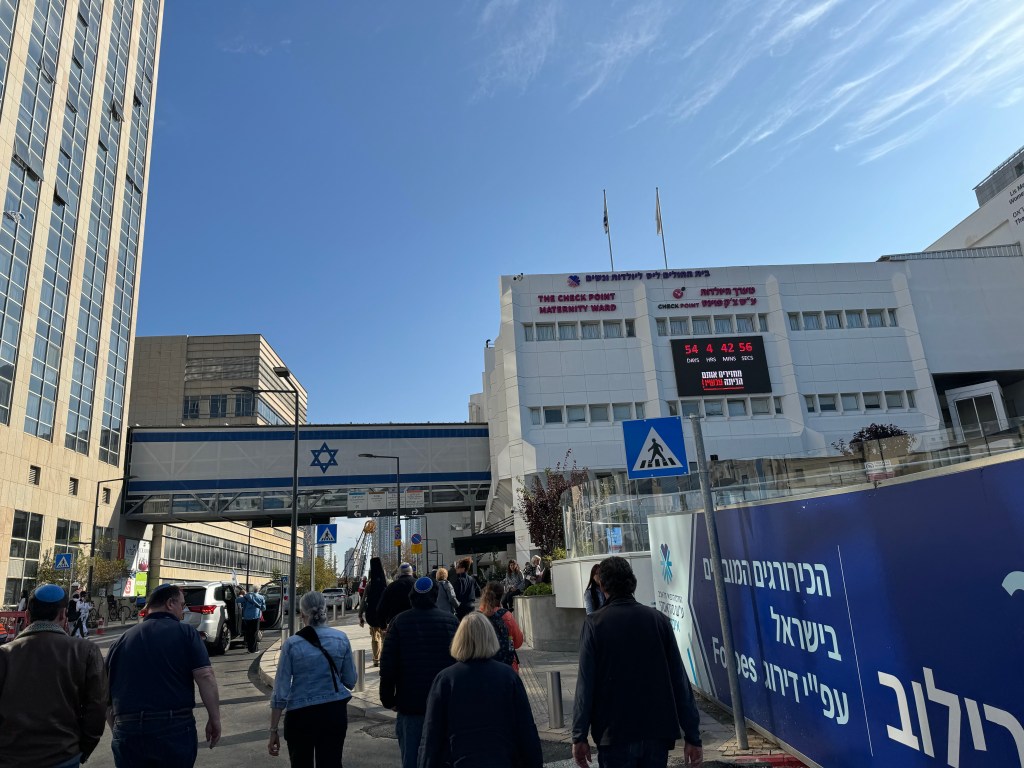
We drive to Tel Aviv en route to Ichilov hospital, the 2nd largest hospital in Israel (also where my cousin Aton Holzer, who I’ve never met, works as a dermatologist -note he is actually out of the country this week!). En route, we discuss some of the updates we’ve been reading and hearing about on the news- hostages held in the homes of physicians and UN personnel, Thai workers testifying that the Israelis, and just the Israelis, who were held with them, being beaten with electrical cables; the misogyny of Israeli intelligence, as a number of female intelligence officers warned of an impending attack only to be dismissed by higher ranking officials; the PR war-Hamas as the one who delivers by attacking Israel and bringing home their imprisoned, while Fatah is all about corruption.
At Ichilov, we meet with the rabbi of the hospital, Rabbi Avraham, who gives us a brief outline of his role as pastor and chief rabbi. Most of the questions he fields are about “kashrus,” as the one who oversees 10,000 kosher meals a day. The most important part of his job is dealing with the ethical issues that come up- this can be a case by case basis, and it can also be how he uses the weekly torah portion to help inform an ethical standard of practice for all the physicians and social workers who work with patients-just thinking of this week’s parsha, when Jacob splits into two camps for fear his brother will kill them all- it’s a story of triage.
I think our delegation of hazzanim is a bit of a shock to the rabbi. Not only are we (men and women) serving in a full time capacity, but our pastoral presence in our communities- visiting congregants in elderly care facilities, hospitals, in trauma, is a different model than in Israel- synagogue clergy rarely visit their members in hospitals. It’s an important realization on his part as we prepare to visit soldiers injured on October 7.
Most of those injured on October 7 went to other hospitals, but over the past few weeks, a number were transferred to Ichilov who required more surgeries and a different level of care. At first, this feels very different from our straight off the plane visit to Hadassah hospital. The first soldier we meet is very matter of fact (we understand that for some, sharing their story is therapeutic, but that’s not the case for everyone): 2 bullets to his shoulder. We learn from others in the room that 18 of the 28 members of his unit were killed, simply unimaginable.
We meet with Yaron, a resident of Kfar Aza. To hear another layer of the story we had heard and seen on Tuesday was powerful. Yaron’s ex wife, along with one of their 3 children, were in Kfar Aza when the ambush began. The two held off for 22 hrs as Hamas gunmen shot at them from their roof. Yaron heard about the attack right away and came INTO Kfar Aza to help. He was shot with an RPG like rifle (something he says he has never seen before). Yaron laid there for 3 hrs before being rescued. He was in a coma for 2 weeks and lost part of his lung. In reflecting on that morning, Yaron speaks of the “beautiful people we lost,” a reminder of the lives, innocent civilian lives, that were cut short by monsters.
Our group gathers in an open space in the rehab floor to sing a number of songs, including the now canonized Acheinu prayer that speaks of the bonds of brotherhood and the need to bring everyone from darkness to light, from captivity to freedom. As we close, a soldier shares that he’s thinking of us during this difficult time in America. He also reiterates an important message that there are different ways to help. For him, having us sing for the patients and their families makes them stronger. Two of us begin a conversation with a mother (originally from Rochester, NY) who waits for her son to return from his IV treatments- he was bartending in Miami Beach just before the holidays, only to return home, enlist, and experience major injury. We added his name in Hebrew to our mi shebeirakh prayers.
After lunch at Serona Market we will make our way to two places where families, friends, and all of Israel come together to shout out Bring Them Home Now. Closing reflections coming soon


Posted on December 1, 2023, in CA Israel Mission. Bookmark the permalink. Leave a comment.


 Hazzan Jesse Holzer
Leave a comment
Comments 0